
Union County Sex Offender Checks
The Oregon Sex Offender Inquiry System is the official public search for Union County. Oregon State Police runs this statewide registry. Select Union in the county field for a county-wide result, or use a name, city, ZIP, or address-radius search. Union County does not maintain a duplicate public list.
Public scope matters. The web system chiefly displays Level 3 registrants, Oregon's highest risk and notification group. Level 1 and Level 2 records are not comprehensively published. A Union County sex offender lookup with no match cannot establish that a person has no duty to report. It only means no public record met the chosen filters and publication rules at that time.
The official registry search image below shows the state source used for Union County results.
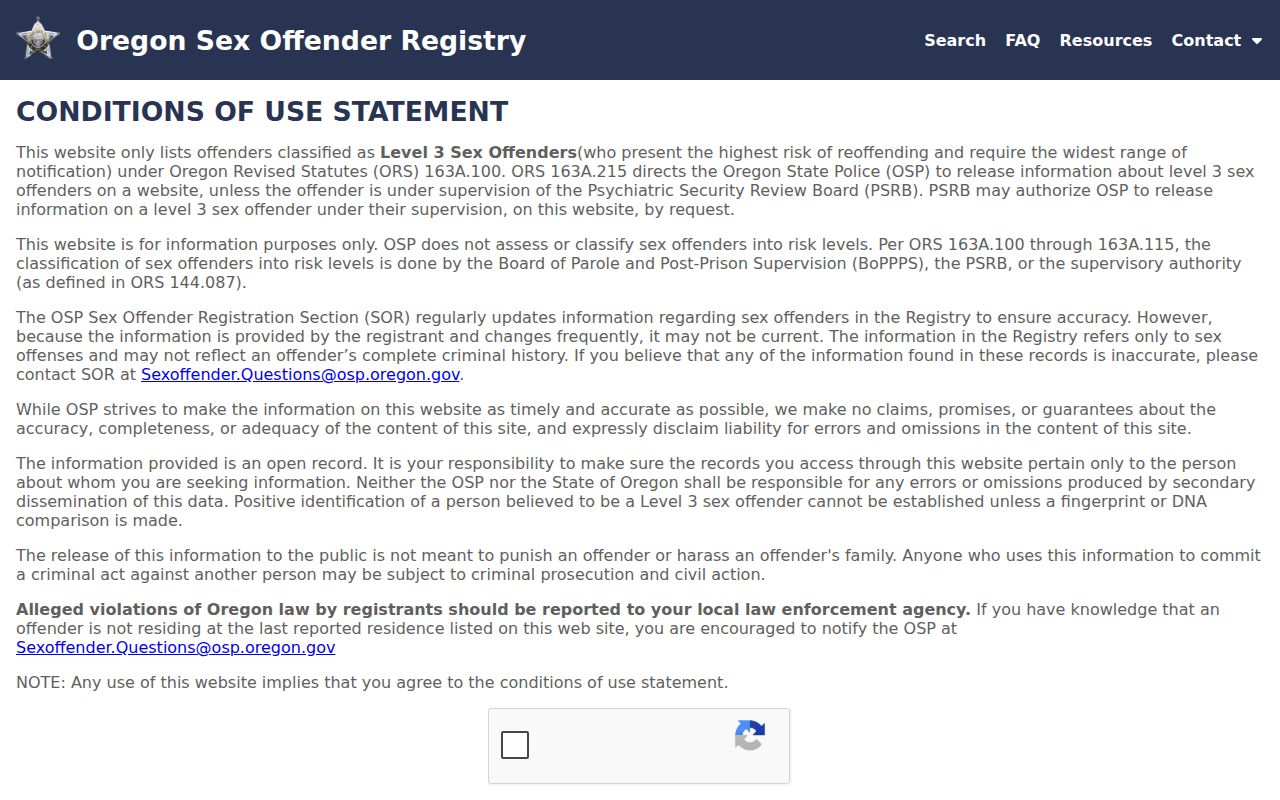
Read the scope notice before interpreting any list or map result.
Union County Sheriff Registration Role
Oregon requires in-person reporting to a local law-enforcement agency in the county of residence. The Union County Sheriff's Office at 1109 K Avenue, La Grande, is the county channel. Its main number is 541-963-1017. A registrant should call first to confirm current hours, appointment practice, identification needs, and whether a city police agency is the right reporting office.
Initial and updated reports follow state deadlines. Oregon residents generally report after release or discharge, during the annual birthday window, and after address or legal-name changes. Higher-education work or attendance changes also trigger reports, while international travel requires earlier notice. The local counter handles compliance. It is not a substitute for the public state search.
Union County Sheriff's Office
1109 K Avenue
La Grande, OR 97850
541-963-1017
Call before appearing for sex offender registration services.
Oregon Sex Offender Inquiry System Searches
The Oregon portal supports criteria, list, and map views. A full valid street address unlocks radius options of 0.5, 1, 2, or 5 miles. Name and location fields can be combined, and a PDF can be made from the current result set. Address mapping is a safety-awareness aid, not a survey or legal boundary tool.
- Open the Oregon registry and read the notice about Level 3 public disclosure.
- Select Union for a county sweep, or enter a name, city, ZIP, or valid street address with a radius.
- Review list and map results, then compare aliases, birth information, photograph, and physical description.
- Open the profile, note its context and date, and report suspected errors to the responsible agency.
| Field Label | Type | Required | Notes |
|---|---|---|---|
| Address Search | Autocomplete | No | Requires a valid geocodable street address |
| Radius | Dropdown | With address | 0.5, 1, 2, or 5 miles |
| Last, First, Middle Name | Text | No | Use one or more name fields to narrow results |
| City and ZIP Code | Text | No | Local location filters |
| County | Dropdown | No | Select Union for county-wide public results |
| Map, List, Download PDF | Controls | No | Changes the view or saves current results |
Union County Registry Visibility Limits
Not every Oregon registrant is visible online. ORS 163A.215 directs public posting of Level 3 information, with a special process for a Level 3 person under Psychiatric Security Review Board supervision. Lower notification levels are not a full public directory. Classification and disclosure exceptions can also affect what appears.
The OSP Sex Offender Registration program explains the statewide system. Its assigned source image is shown below.
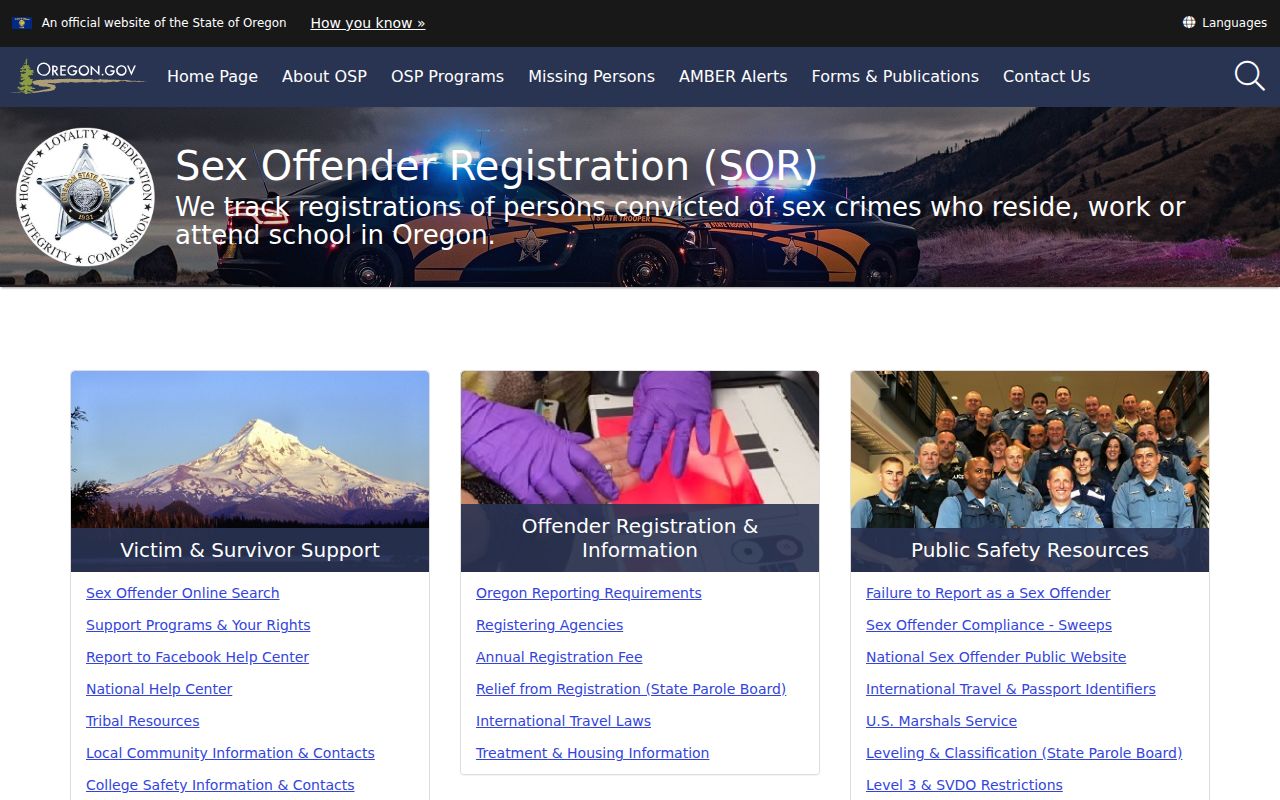
A blank search should prompt a scope check, not a broad claim about registration status.
Registry Profiles: What They Show
A public Union County profile can display identity, address, physical, and offense fields. Not every field is filled in every record. The result may say that no primary address is on file. Vehicle, school, victim, and compliance data should not be assumed unless the specific public entry shows them.
| Name and Aliases | Last, first, middle, suffix, date of birth, age, and separately listed aliases. |
|---|---|
| Photo and Description | Photo when available, sex, height, weight, hair, eyes, scars, marks, and tattoos. |
| Registered Address | Street, city, state, ZIP, county, or notice that no primary address is on file. |
| Offense Information | Separate offense section with offense details and codes returned by the profile service. |
| Work Information | Employer name and address when included in the public record. |
| Map and PDF | Residence coordinates may support map view; details can be saved as a PDF. |
OSP states that fingerprint or DNA comparison is needed for positive identification. Similar names and photos are not conclusive. Registry details can change often because registrants provide much of the data. Suspected inaccuracies belong with OSP or local law enforcement, not in a public accusation.
Union County State and National Search
The Oregon registry is the strongest first source for Union County geography because it exposes the state's fields and rules. For someone who may cross state lines, use the U.S. Department of Justice National Sex Offender Public Website. NSOPW sends searches across participating jurisdictions, but each state's own publication limits still govern what can be returned.
The official NSOPW source image demonstrates that cross-state layer.
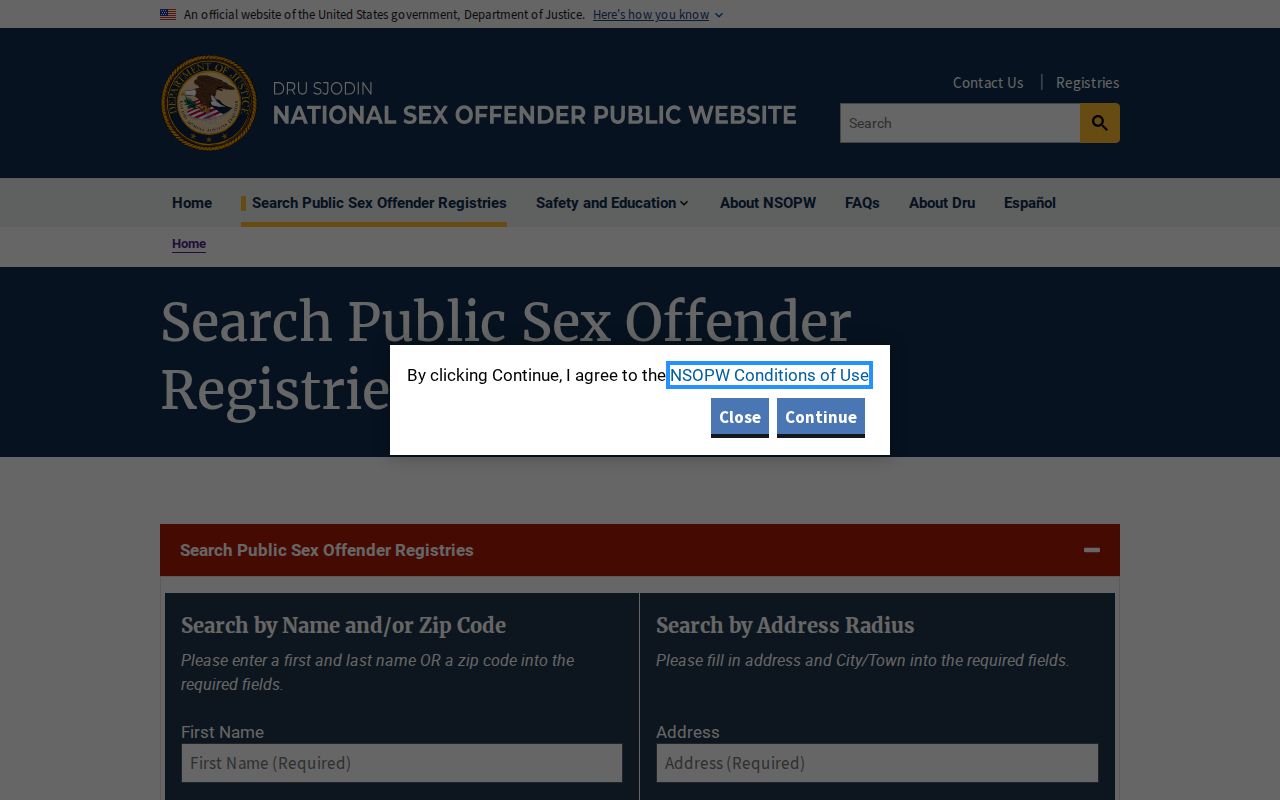
Use custody tools for jail or prison status. Registration address, supervision, and current custody are separate facts held in different systems.
Registration Levels and Duties in Oregon
Oregon uses Levels 1 through 3 as risk and notification classifications, not as simple federal duration tiers. The Board of Parole and Post-Prison Supervision handles adult risk assessment and classification, while the Psychiatric Security Review Board has its own process for people under its authority. Higher levels permit broader notice.
| Oregon Level | Public Visibility and Notice | Duration or Relief Path |
|---|---|---|
| Level 1 | Narrow notice; not comprehensively posted on the Level 3 public site | An eligible adult may petition after the applicable statutory waiting period, commonly described as 10 years after supervision ends |
| Level 2 | May include neighbors and specified community places; not fully public online | Eligible reclassification to Level 1 may be sought after 10 years, followed by a further published waiting period before relief |
| Level 3 | Widest notice, including the OSP public registry and local or regional media | May seek eligible reclassification to Level 2, but published guidance does not allow a move below Level 2 |
Relief is not automatic when time passes. It depends on eligibility, a petition, and an official decision under ORS 163A.120 through 163A.150. Ending an Oregon reporting duty does not erase the underlying conviction from the criminal court record.
Union County Residence Rule Limits
Oregon does not impose one simple county-wide distance rule on every registrant. Residence and contact restrictions may depend on the offense, notification level, supervision status, and terms imposed in the individual case. ORS 144.642 addresses criteria for some supervised registrants, while ORS 163.476 and 163.479 apply child-location or contact limits to specified groups.
The OSP registry statutes and restrictions page collects the governing sources. Its manifest image appears below.
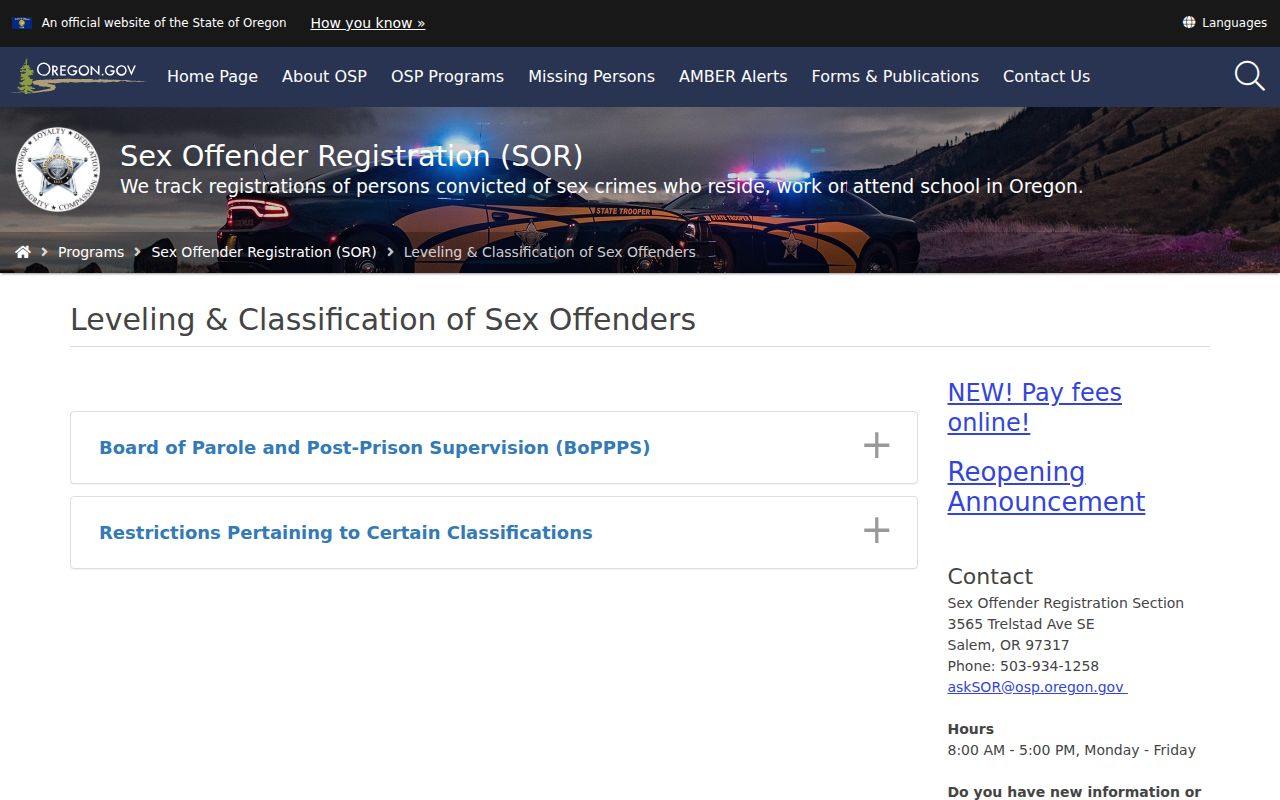
A radius map result must not be treated as proof that a home violates a court or supervision rule.
Report Union County Registry Errors
For suspected noncompliance or inaccurate details, contact the OSP Sex Offender Registration Section at 503-934-1258 or askSOR@osp.oregon.gov. The state office is at 3565 Trelstad Avenue SE, Salem, and lists weekday hours from 8:00 a.m. to 5:00 p.m. Union County reports may also go to the Sheriff's Office. Inside a city, its police department may be the quickest local channel.
Give the source URL, the observed discrepancy, when it was seen, and objective facts. Do not trespass, conduct surveillance, confront a person, or publish an accusation. If there is immediate danger or suspected criminal conduct, call 911. The OSP offender information guidance describes reporting duties and state contacts.
The official guidance image below ties those steps to the Oregon source.
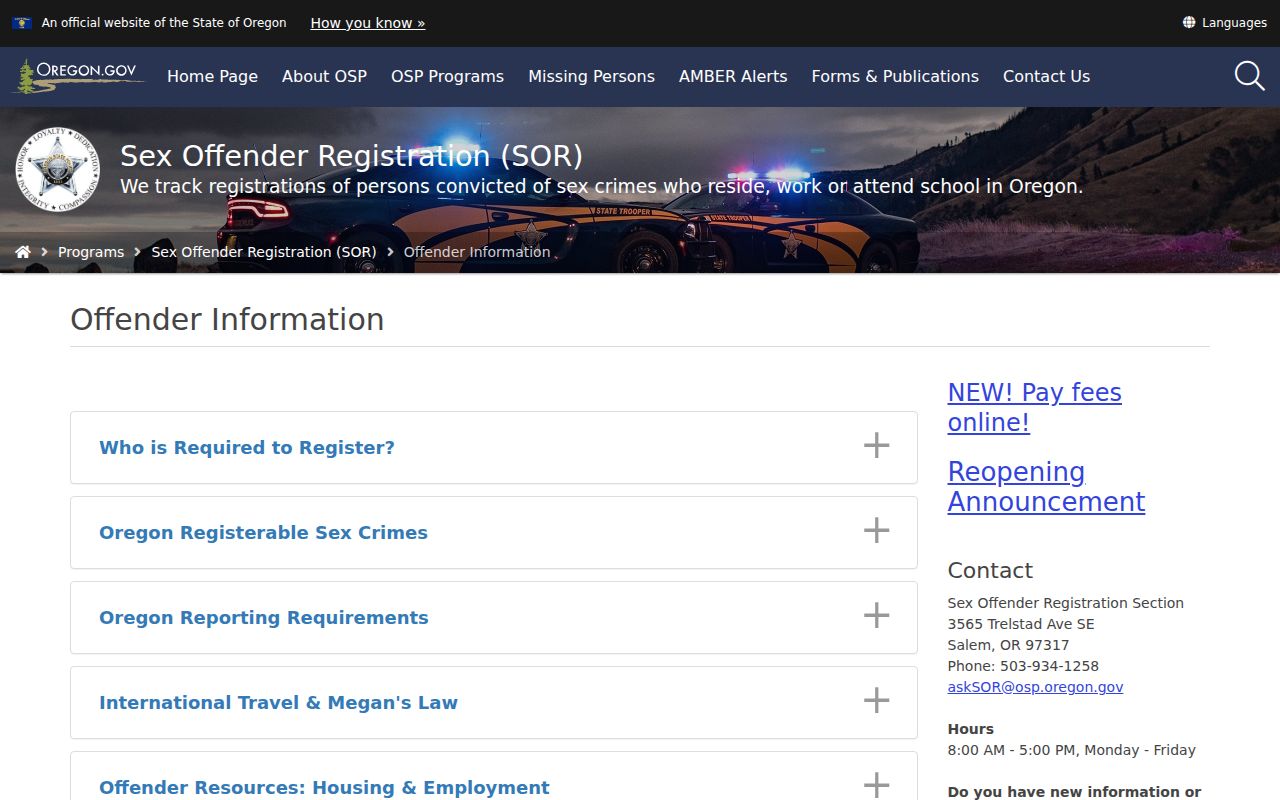
Report facts to the agency that can verify and correct the official record.
Using Registry Information Lawfully
Union County registry information supports personal safety, family planning, and community awareness. A listed address does not prove that a person is present at a given moment, and it does not imply that anyone else at that address is registered. The registry covers sex-offense reporting information, not the person's full criminal history. Check an underlying judgment through the Union County court case lookup when the legal case outcome matters.
Use records lawfully: ORS 163A.205 through 163A.225 govern disclosure. Never use registry information to threaten, harass, intimidate, commit violence, or take vigilante action.
Oregon's current registry research did not confirm an email or proximity-alert subscription. Do not rely on an unofficial alert promise. Level 3 permits the broadest proactive notice, while Level 2 notice can reach neighbors and specified community locations. The state and local agencies control lawful notification.